
Co-author: Ahmed Abdullah bin Farooqi Rayhan
Presented: 25 May 2024
Event: Critical Affective Pedagogy for Bangladesh
Organized by: Department of English, Jahangirnagar University
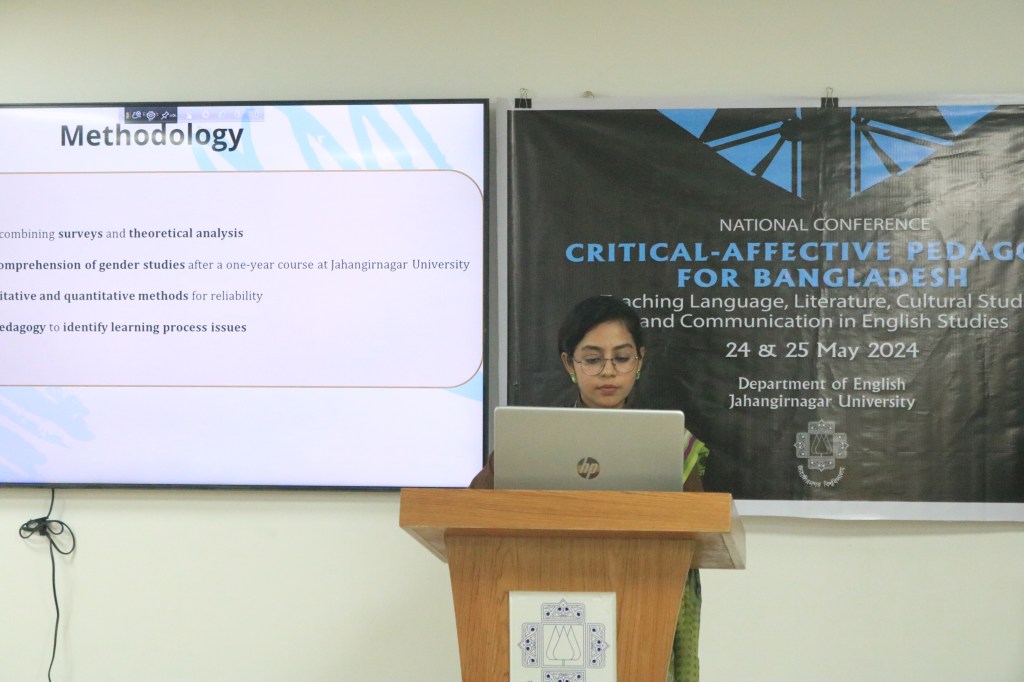
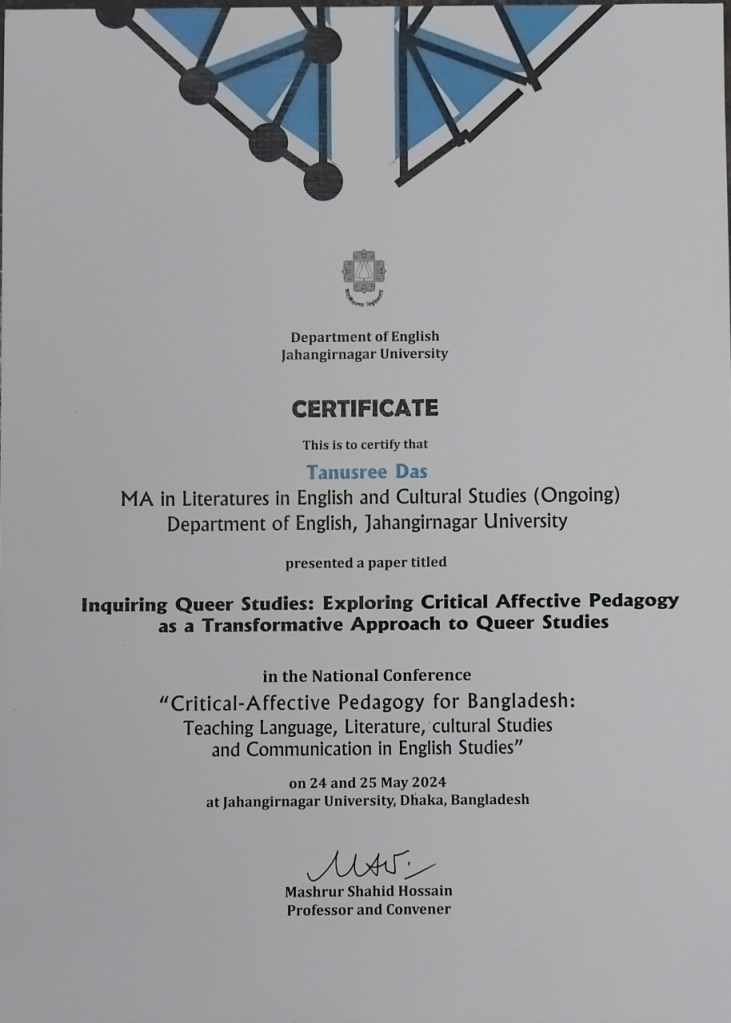
On 25 May 2024, our research titled “Inquiring Queer Studies: Critical Affective Pedagogy as a Transformative Framework for Gender and Sexuality Education in Bangladeshi Tertiary Institutions” was presented at Critical Affective Pedagogy for Bangladesh, organized by the Department of English, Jahangirnagar University.
The study explores an important challenge within gender and queer studies education in Bangladesh: how can educators move beyond conventional, predominantly rote-learning approaches to foster genuine understanding, critical engagement, and empathy when teaching gender and sexuality?
Gender and queer studies courses in Bangladeshi tertiary institutions operate within a complex socio-cultural environment. Conservative attitudes surrounding gender and sexuality, established traditions of memorization-based learning, and the emotional distance many students experience from these subjects can make meaningful classroom engagement particularly difficult.
Drawing on critical pedagogy (Freire, 1970; Giroux, 1988; hooks, 1994), affect theory (Ahmed, 2004; Massumi, 2002), and critical affective pedagogy (Boler, 1999; Keddie, 2010), our research examines how education can engage not only students’ intellectual understanding but also their emotional responses to questions of gender, sexuality, difference, and identity.
Using a mixed-methods approach, the study combines survey data from students at Jahangirnagar University who had completed at least one year of gender studies instruction with a theoretical analysis of critical affective pedagogical practices. The findings indicate notable gaps in comprehension and emotional engagement among students exposed exclusively to conventional pedagogical methods.
In response, the study proposes five contextually adapted critical affective pedagogical strategies for Bangladeshi tertiary education:
- Cultural Sensitivity — situating discussions of gender and sexuality within students’ cultural and socio-economic realities while maintaining space for critical inquiry.
- Reparative Reading — encouraging students to approach texts and identities beyond suspicion or predetermined judgment and remain open to alternative meanings and experiences.
- Reflection and Reflexivity — enabling students to examine how their own assumptions, social positions, experiences, and emotions shape their understanding of gender and sexuality.
- A Reading Resilience Toolkit — developing students’ capacity to engage thoughtfully with unfamiliar, challenging, or emotionally demanding materials.
- Intentional Embrace of Emotional Responses — recognizing discomfort, resistance, empathy, uncertainty, and other emotional responses as meaningful components of the learning process rather than obstacles that must simply be suppressed.
The research argues that critical affective pedagogy can offer a transformative framework for gender and sexuality education in Bangladesh. Rather than treating students as passive recipients of theoretical knowledge, this approach creates opportunities for them to interrogate assumptions, reflect on emotional responses, and develop more nuanced understandings of gender-diverse and queer identities.
By bringing queer studies, affect theory, and critical pedagogy into conversation with the particular realities of Bangladeshi higher education, the study also seeks to contribute to the still underrepresented body of pedagogical scholarship emerging from South Asian contexts.
The presentation at Jahangirnagar University provided an important opportunity to consider how emotionally engaged, culturally responsive, and critically reflective pedagogies might help create more inclusive and meaningful spaces for teaching gender and sexuality in Bangladesh.

 Tanusree Das